Research overview
Multilingual NLP, Cultural Adaptation, and Social Bias in AI
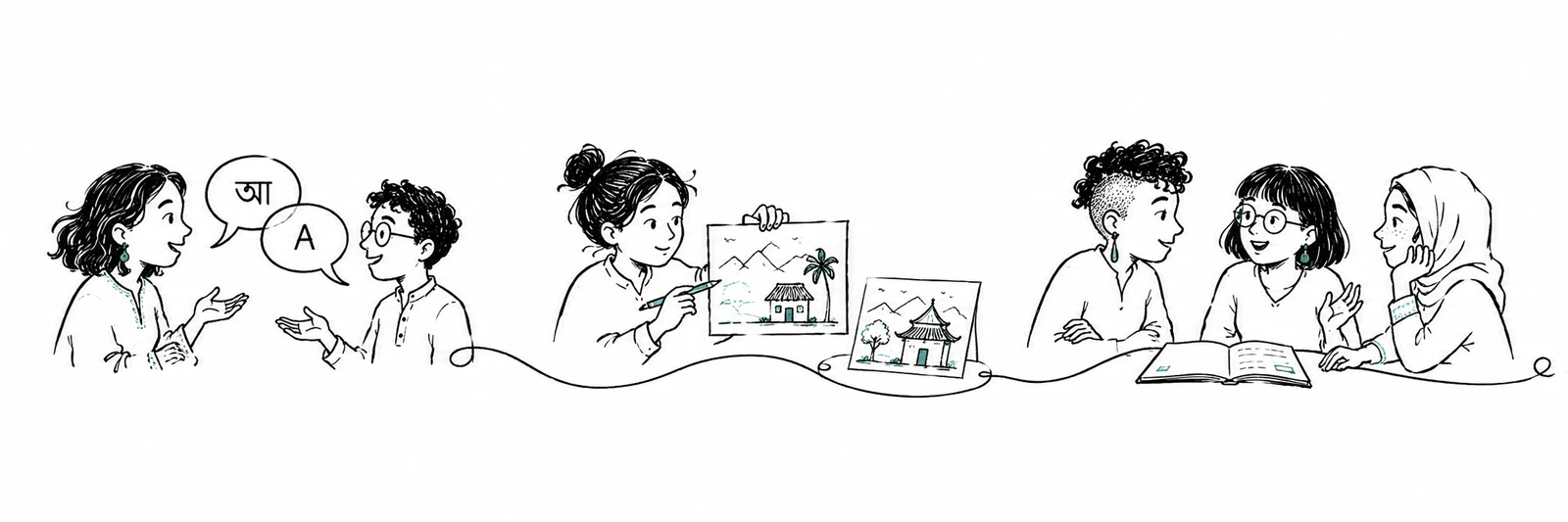
My research examines how language and culture shape the behavior of AI systems. I study multilingual language models, develop ways to adapt text and images to local contexts, and evaluate and mitigate social biases. These directions connect a shared question: how can AI serve people whose languages and cultures are poorly represented in its training data?
Understanding multilingual and multicultural AI
A model’s ability to produce text in a language does not tell us how reliably it behaves in that language, or what it understands about the people who use it. My work examines this gap at both the behavioral and representational levels.
Double Trouble uses controlled bilingual pretraining to examine how learning another language changes English representations. Tower of Babel studies the mismatch between claimed language support and actual model behavior. Global Voices extends bias evaluation across languages with culturally grounded data. Together, these studies examine assumptions that can be missed when English performance is treated as a proxy for multilingual competence.
Related publications
-
Double Trouble: Bilingual Pretraining Leaves Language-Conditioned Effects in Shared-Language Representations
EMNLP ’26 (Main)
We show that bilingual pretraining changes deeper English representations across eight language pairs, even when the models’ word embeddings align.
Read paper: Double Trouble: Bilingual Pretraining Leaves Language-Conditioned Effects in Shared-Language Representations · Code: Double Trouble: Bilingual Pretraining Leaves Language-Conditioned Effects in Shared-Language Representations
-
Lost in the Tower of Babel: The Adverse Effects of Incidental Multilingualism in LLMs
COLM ’26
We expose gaps between the languages LLMs claim to support and their actual behavior, arguing for multilingualism as a deliberate design goal.
Read paper: Lost in the Tower of Babel: The Adverse Effects of Incidental Multilingualism in LLMs · Code: Lost in the Tower of Babel: The Adverse Effects of Incidental Multilingualism in LLMs
-
Global Voices, Local Biases: Socio-cultural Prejudices across Languages
EMNLP ’23 (Main)
We expand social-bias evaluation to 24 languages with culturally grounded data and examine regional biases across six Indian languages.
Read paper: Global Voices, Local Biases: Socio-cultural Prejudices across Languages · Code: Global Voices, Local Biases: Socio-cultural Prejudices across Languages
Adapting text and image generation to local contexts
The same question can have different correct answers in different places, and the same visual concept can take different cultural forms. I study how models can use this context when generating answers and images.
MAPLE tests whether geographic metadata during pretraining helps models select locale-appropriate answers, using LocalNewsQA to measure whether answers change with the locale. Crossroads examines cultural artifacts in images and uses them for cultural adaptation. Global Gallery studies how instruction tuning and bilingual pretraining affect cultural knowledge. Across these settings, the aim is to evaluate local appropriateness explicitly, rather than assume it follows from general model capability.
Related publications
-
MAPLE: Metadata Conditioned LLM Pretraining for Locale-Aware Question Answering
EMNLP ’26 (Main)
We introduce MAPLE and LocalNewsQA to show how geographic metadata during pretraining helps language models choose answers that fit a question’s locale.
Read paper: MAPLE: Metadata Conditioned LLM Pretraining for Locale-Aware Question Answering · Code: MAPLE: Metadata Conditioned LLM Pretraining for Locale-Aware Question Answering
-
Crossroads of Continents: Automated Artifact Extraction for Cultural Adaptation with Large Multimodal Models
WACV ’25
We introduce DalleStreet and CultureAdapt to study cultural associations in multimodal models and use extracted artifacts to adapt images to local cultural contexts.
Read paper: Crossroads of Continents: Automated Artifact Extraction for Cultural Adaptation with Large Multimodal Models · Code: Crossroads of Continents: Automated Artifact Extraction for Cultural Adaptation with Large Multimodal Models
-
Global Gallery: The Fine Art of Painting Culture Portraits through Multilingual Instruction Tuning
NAACL ’24 (Poster)
We study how language-specific instruction tuning and bilingual pretraining affect cultural knowledge across six languages, revealing uneven gains and persistent cultural biases.
Read paper: Global Gallery: The Fine Art of Painting Culture Portraits through Multilingual Instruction Tuning · Code: Global Gallery: The Fine Art of Painting Culture Portraits through Multilingual Instruction Tuning
Evaluating and mitigating social bias in AI
Bias evaluations need to account for the social contexts in which models are used. I study associations that familiar stereotype-based tests can overlook, including culturally specific and intersectional biases in multilingual and multimodal settings.
BiasDora probes hidden associations in vision-language models, while our South Asian bias study examines open-ended generation across ten languages. Breaking Bias applies ideas from intergroup contact to instruction tuning. KnowBias explores a different intervention: strengthening neurons that encode knowledge about bias. This work connects broader evaluation with methods for reducing bias while retaining useful model capabilities.
Related publications
ICML ’26 (Poster)
We introduce KnowBias, which reduces social bias by strengthening bias-knowledge neurons using a few yes/no questions, without retraining and with minimal loss of general capability.
Read paper: Knowing Bias, Doing Better: Mitigating Social Bias in LLMs via Know-Bias Neuron Enhancement · Code: Knowing Bias, Doing Better: Mitigating Social Bias in LLMs via Know-Bias Neuron Enhancement
TrustNLP @ ACL ’26
We measure culturally specific, intersectional biases across ten South Asian languages and test whether prompting reduces them in open-ended generation.
Read paper: Measuring South Asian Biases in Large Language Models · Code: Measuring South Asian Biases in Large Language Models
EMNLP Findings ’24 (Poster)
We uncover hidden social associations across nine bias dimensions in vision-language models, revealing subtle and extreme biases that familiar stereotype-based evaluations can miss.
Read paper: BiasDora: Exploring Hidden Biased Associations in Vision-Language Models · Code: BiasDora: Exploring Hidden Biased Associations in Vision-Language Models
AIES ’24
We adapt the contact hypothesis from social psychology to reduce language-model bias through simulated intergroup interactions and instruction tuning.
Read paper: Breaking Bias, Building Bridges: Evaluation and Mitigation of Social Biases in LLMs via Contact Hypothesis · Code: Breaking Bias, Building Bridges: Evaluation and Mitigation of Social Biases in LLMs via Contact Hypothesis